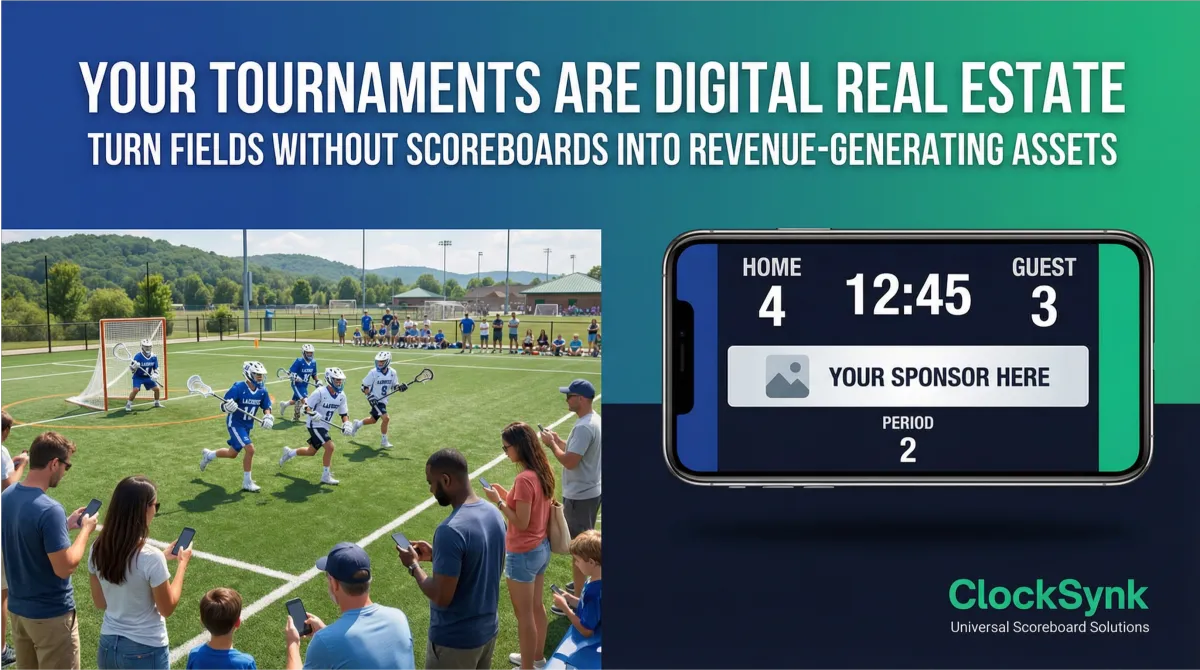
Turn Youth Sports Fields Into Revenue-Generating Digital Assets
Walk into any multi-field youth sports complex on tournament weekend, and you'll see the same scene: eight fields, hundreds of parents, dozens of teams, and zero scoreboards. Not broken scoreboards. Not outdated scoreboards. No scoreboards at all.
Tournament companies rent these facilities and deploy interns with clipboards and walkie-talkies to manage scoring. Team management apps have tried to fill the gap, but they create a new problem: multiple conflicting sources of truth. One team's parent runs one app showing one score. The other team's parent runs a different app showing something different. Grandparents, aunts, and uncles who aren't part of either app get misinformation from parents yelling across fields. Meanwhile, every sponsor opportunity is limited to static banners that nobody remembers.
This isn't just operational chaos—it's a massive revenue opportunity hiding in plain sight. The tournament companies that solve this problem first will capture sponsors that their competitors cannot access.
The Real Problem: Multiple Sources of Truth (And None of Them Universal)
Here's what actually happens at a typical youth lacrosse tournament:
Team A's parent is running a team management app on their phone. They're trying to track stats for their kid, so they're updating scores as they see them. Their app shows Team A winning 8-6.
Team B's parent is running a different team management app because that's what their club uses. They're updating based on what they hear from the sideline. Their app shows the game tied 7-7.
The tournament intern is flipping over an old-school gym class scoreboard and calling scores in on a walkie-talkie to the tournament director, who's manually updating schedules on a whiteboard.
Coaches running the sidelines need to see the game clock and penalty timers—time left in the period, when the man-up ends—but they see nothing. They're yelling to the intern, "How much time?" between plays.
Every other parent, grandparent, aunt, and uncle who isn't part of either team's app sees nothing. They're walking between fields, interrupting the intern, or getting conflicting information from other parents.
The people who matter most -- coaches managing the game, sponsors funding the event, extended family traveling to watch, and most importantly, the players playing the game—have access to none of the information they need.
This is the reality of youth sports in 2025. Team management apps have tried to fill the gap, but they've created a new challenge: instead of one source of truth, we now have multiple conflicting sources.
Sports Parents Are Drowning in Apps

I have 14 apps on my phone just for my kids' sports. Tournament registration apps. Team communication apps. Scheduling apps. Carpool coordination apps. Photo sharing apps. Each team, each league, each tournament adds another app to download, another login to remember, another notification to manage.
Parents are exhausted. The last thing they want is to download another app to see a score.
You wouldn't trade in a jumbotron for an email flow. You shouldn't trade universal scoreboards for team-specific apps that only work for people who downloaded them, logged in, and figured out which team page to follow.
What tournament companies need—and what sponsors will pay for—is a universal source of truth that works for everyone, instantly, without downloads or logins.
Why Most Facilities Have No Scoreboards (And Why That Creates Opportunity)
The reason is economics: traditional scoreboards cost $15,000-$50,000 per field. For an 8-field complex, that's $120,000-$400,000 in upfront hardware costs. Add another $40,000-$80,000 for installation and electrical work, and you're looking at a quarter-million-dollar investment before displaying a single score.
Facilities that rent to tournament companies don't make that investment because they don't capture the revenue upside. The facility gets a flat rental fee. The tournament company gets the sponsorship revenue. Neither party has incentive to spend six figures on permanent infrastructure.
So tournaments operate without scoreboards, accepting the operational chaos as unavoidable. But here's what changes the equation: digital scoreboards for fields without scoreboards create a universal source of truth that works instantly for everyone—and turns every game into measurable sponsor inventory.
How Tournament Companies Are Turning Chaos Into Revenue

Here's what happened when Victory Elite Lacrosse deployed ClockSynk at the Pittsburgh Fall Classic:
Before: Interns flipped gym class scoreboards and radioed scores to the tournament director. Parents ran team management apps with conflicting information. Extended family had no access to live scoring. Sponsors paid for banners with zero measurable engagement.
After: Interns used a simple interface to keep score and stats in real time. Industrial-strength tripods with iPads on each sideline displayed the game clock and penalty timers so coaches could see exactly how much time remained and when man-up situations ended. Parents saw updates instantly on their phone—no app download, no login, just scan a QR code once. Everyone saw the same score at the same time. And sponsors got verified engagement data they'd never had access to.
The verified results over a single weekend:
375 unique users accessed the universal scoreboard
2,196 page views representing verified brand impressions
4 minutes 10 seconds average engagement time per session
This wasn't a tech-savvy tournament with early adopters. These were regular parents doing what they always do—checking their phones. The difference was that instead of finding conflicting information or nothing at all, they found a universal source of truth. One score. One clock. One platform that worked for everyone.
The Hidden Cost of Operational Chaos

Tournament companies running events without universal scoring infrastructure pay costs they don't see on the balance sheet:
Intern Time Waste
Interns spend their weekends managing information flow instead of improving the tournament experience. They're fielding constant questions: "What's the score on Field 7?" "When does the next game start?" "Which field is the U12 championship on?"
Every question is time spent not checking in teams, not managing safety issues, not helping with logistics. The operational burden compounds as tournaments scale.
Parent Satisfaction Erosion
When parents compare your tournament to competitors with better information systems, they choose the competitor—even if it means paying more or driving farther. Registration retention is directly tied to experience quality, and information chaos degrades that experience.
Sponsor Value Destruction
This is where "no universal scoreboard" becomes expensive. Traditional thinking says you need a physical scoreboard to sell scoreboard sponsorships. That's backwards.
They want their brand in front of parents during the exact moment those parents are most engaged—while watching their child compete. A physical scoreboard provides this during games. But a digital scoreboard app provides it continuously, on every parent's personal device, with measurable engagement data that traditional signage can never offer.
that could generate significant revenue per season with the right system.
How to Monetize Tournament Digital Infrastructure

Here's the complete playbook for turning tournaments without scoreboards into revenue-generating operations:
Step 1: Deploy a Universal Scoreboard System
A web-based scoreboard eliminates both the capital barrier and the app fatigue problem. Here's the actual deployment process:
Pre-Tournament Setup:
Upload your tournament schedule
Generate QR codes for each field
Print QR codes on simple signage or display on tablets at each field
Tournament Day:

Interns use the simple scoring interface instead of gym class scoreboards and walkie-talkies
Industrial-strength tripods with iPads on each sideline display the game clock and penalty timers for coaches
Parents scan the QR code once—no app download, no login required
Scores update in real time across all devices
Everyone—coaches, parents, extended family, sponsors—sees the same information simultaneously
Total setup time: 2-3 hours Total capital investment: $0 Parent friction: Zero (no app download required)
The intern who was flipping scoreboards and calling in scores on a walkie-talkie now uses a simple interface to keep score and stats in real time. Parents see the updates on their phone scoreboard instantly. Grandparents visiting from out of state scan the QR code and follow along. Sponsors see their brand on every screen, with verified engagement data.
Step 2: Structure Sponsorship Packages Around Verified Engagement

With a universal source of truth and engagement data, you can offer sponsors something they've never had access to: measurable youth sports sponsorship opportunities with verified ROI.
Tournament Sponsor Package:
Brand logo displays on the universal scoreboard throughout the tournament
Estimated impressions based on field configuration:
Single-field sponsor: Exclusive field branding for one designated field
Tournament-wide sponsor: Maximum engagement frequency across all fields
Post-event analytics report showing:
Total unique users who saw their brand
Average engagement time per user
Total sessions and page views
Verified impression counts
Season Sponsor Package:
Brand presence across all tournaments in your circuit
Choose between:
Field-specific sponsorship: Exclusive branding on designated fields
Tournament-wide sponsorship: Maximum engagement frequency across all fields
Real-time analytics dashboard access
Category exclusivity (only sports medicine clinic, only restaurant chain, etc.)
League-Wide Sponsor Package:
Brand presence across multiple tournament companies in the same league
Reach thousands of families across dozens of events
Enterprise-level analytics and reporting
Integration with other league marketing channels
Compare this to traditional banner sponsorships with zero measurable data. A scoreboard app with sponsor ads transforms sponsorship from charity into marketing investment with proven ROI.
Step 3: Prove ROI with Pilot Sponsors

Don't try to sell the entire model at once. Start with one pilot sponsor who understands digital marketing:
Offer them a pilot opportunity at your next tournament
Collect detailed engagement data
Present a comprehensive analytics report showing:
Total unique users who saw their brand
Average engagement time
Total impression count
Verified page views
When you can show a local sports medicine clinic that hundreds of parents spent an average of 4+ minutes with their brand visible—with verified impression data—you're no longer asking for sponsorship. You're offering advertising inventory with measurable performance.
Step 4: Scale Across Your Tournament Circuit
Once you've proven the model with one sponsor and one event, expansion becomes straightforward:
Deploy at every tournament in your circuit
Offer season-long packages covering all events
Recruit additional sponsors in non-competing categories
Partner with other tournament companies for league-wide packages
A tournament company running 15-20 events per season can deliver sustained engagement time to sponsors throughout the year, creating recurring revenue streams that extend far beyond traditional seasonal sponsorships.
The Competitive Advantage: Universal Truth vs. App Chaos

Here's why tournament companies that deploy universal scoring infrastructure will dominate their markets:
Tournaments without universal scoreboards:
Operational chaos with interns managing walkie-talkies and clipboards
Parent frustration with conflicting information from team management apps
Extended family with zero access to live information
Sponsors paying for unmeasurable banner placements
Tournaments with universal digital scoreboards:
Streamlined operations with interns using simple scoring interfaces
One source of truth that works for everyone, instantly
Zero app downloads or logins required (eliminating parent friction)
Sponsors receiving verified engagement data with measurable ROI
The tournament company that moves first in their market captures the highest-value sponsors. Once a regional bank or sports medicine clinic sees verified ROI from your platform, they're not switching to a competitor offering unmeasurable banner placements.
Why "No App Download" Matters More Than You Think
Every app download is a conversion barrier. Consider the difference:
With an app requirement:
Parent scans QR code or clicks link
Redirected to app store
Decides whether to download (significant drop-off)
Waits for download and installation
Opens app and creates account or logs in
Navigates to correct tournament/team/game
With a web-based scoreboard:
Parent scans QR code
Scoreboard loads instantly in browser
Immediate access to live scores
This isn't just about convenience. It's about sponsor value. When more parents engage instantly instead of abandoning at the app store, your sponsor impressions multiply. When average engagement time is measured in minutes instead of seconds, sponsor value increases proportionally.
You wouldn't trade in a jumbotron for an email flow. Don't trade universal scoreboards for team-specific apps -- they are two completely different things that should co-exist.

Implementation: Your 30-Day Roadmap
Here's exactly how to go from "no scoreboard" to "revenue-generating digital infrastructure" in one month:
Week 1: Platform Selection and Sponsor Outreach
Evaluate cloud-based scoreboard platforms
Configure fields and test scoring interface with interns
Identify 3-5 potential pilot sponsors
Prepare pitch deck with engagement projections
Week 2: Intern Training and Testing
Train interns on the scoring interface (typically 15-20 minutes)
Run test games with staff to identify any workflow issues
Generate QR codes and prepare field signage
Refine processes based on feedback
Week 3: First Live Tournament Deployment
Deploy QR codes at each field
Have interns use the scoring interface instead of gym scoreboards
Monitor engagement in real-time
Troubleshoot any user experience issues
Collect comprehensive analytics data
Week 4: Sponsor Presentations and Scaling
Compile analytics report with actual engagement data
Present results to pilot sponsors with specific metrics
Close first sponsorship deals for upcoming tournaments
Plan rollout across your entire tournament circuit
Total time investment: 20-30 hours Total capital investment: $0
The Investment Thesis: Universal Truth in Youth Sports

For investors and entrepreneurs evaluating opportunities in youth sports, the "universal source of truth" problem represents a significant market opportunity:
Market Size:
Youth sports is a $19+ billion industry
Estimated 30,000+ multi-field sports complexes in the US
Thousands of tournament companies running events at these facilities
70%+ have no electronic scoreboards due to capital constraints
The Problem:
Multiple conflicting sources of truth
App fatigue (parents already have numerous sports apps)
Extended family excluded from team-specific apps
Sponsors have zero measurable data
Tournament companies leave revenue on the table
The Solution:
Universal web-based scoreboard requiring no app download
One source of truth accessible to everyone instantly
Verified engagement data for sponsors
Zero capital investment for tournament companies
The tournament companies that deploy scoreboard revenue generation infrastructure first will dominate their local markets. The platforms that enable this transformation will capture a meaningful share of the youth sports economy.
Taking Action: Create Your Universal Source of Truth

If you run tournaments at facilities without scoreboards, you have three options:
Option 1: Continue with Current Chaos
Interns waste time with walkie-talkies and clipboards
Parents get conflicting information from multiple team apps
Extended family has no access to live scoring
Sponsors pay for banners with zero measurable ROI
Competitors deploy better systems and steal your market share
Option 2: Tell Parents to Download Another App
Add to app fatigue (parents already have 10-15+ sports apps)
Create conversion barriers (significant drop-off at app download)
Fragment your audience (only team parents download, extended family excluded)
Deliver fraction of potential sponsor impressions
Option 3: Deploy Universal Web-Based Infrastructure
Invest zero capital
Go live at your next tournament (30-day timeline)
Eliminate app download friction
Generate new sponsorship revenue with verified engagement data
Provide superior experience for parents, extended family, and sponsors
Capture market-leading sponsors with measurable ROI
The choice is clear. The technology exists today. The business model is proven with real data from Victory Elite Lacrosse and other tournament companies. The only question is whether you'll deploy it before your competitors do.
Your tournaments are digital real estate. Every game creates guaranteed attention. Stop giving that value away for free.
Learn more at ClockSynk.com
#YouthSports #SportsTech #Entrepreneurship #SportsBiz #Sponsorship #DigitalAssets #SportsInvestor #DataDrivenCoaching #YouthSportsManagement #TournamentDirector #DigitalRealEstate #LacrosseTournament


